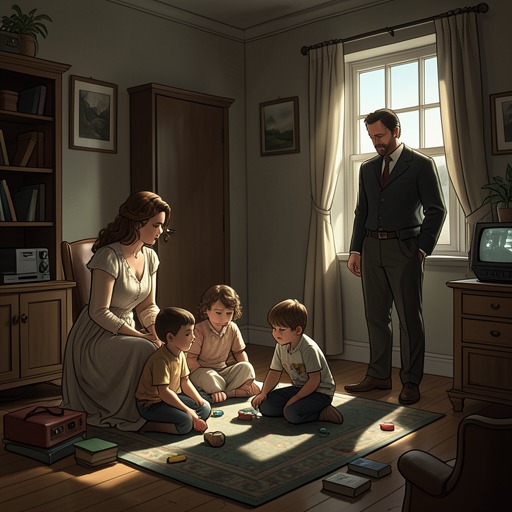
Yuri Zhivago and Sasha relationship
Doctor ZhivagoYuri Zhivago and Sasha’s relationship is shaped from the outset by separation: Yuri is mobilized soon after the boy’s birth, and when he returns to Moscow he scarcely knows his son. Before they meet, he imagines Sasha’s individuality in a cry heard from a hospital nursery; when they finally face one another, the child responds not with recognition but with fear and a slap. The first encounter makes the distance between biological fatherhood and an earned intimacy concrete, while Yuri’s confident promise that they will become inseparable sits uneasily beside the foreboding he carries away.
Birth and separation
When Tonia gives birth, Yuri rushes to the hospital and hears her anguished screams from the passage. He is not allowed into the ward. Waiting outside, he hears a newborn’s cry and murmurs with relief that Tonia is safe. The nurse tells him that the baby is a boy and congratulates him on the delivery, but Yuri barely takes in the news. His joy is focused on Tonia’s survival, and he does not feel that he has earned a father’s pride: the child seems to him a gift arriving from beyond his own participation.
That first response establishes a tension that will persist in the relationship. Fatherhood is announced to Yuri as a fact, but at this moment it remains emotionally abstract; the life most immediately present to him is Tonia’s, endangered and now safe. He does not yet know his son as a person, and the child’s arrival does not undo the vulnerability of the mother or make Yuri an intimate presence in the baby’s life.
Yuri is mobilized almost as soon as Sasha is born. The boy is therefore the most important thing awaiting him in Moscow, yet Yuri admits that he hardly knows him. On a visit to Tonia while she is still in hospital, he is already in uniform and about to leave the city. Because he arrives at feeding time, he cannot enter the nursery. He sits in the waiting room and hears a chorus of ten or twelve babies, carried down the corridor by nurses bundled up against the cold. His brief access to fatherhood is auditory and distant: he hears infants being taken to their mothers, but cannot join them.
A voice imagined as a person
Among the babies’ repeated cries, one voice stands out to Yuri. It does not sound more distressed than the others, but it seems deeper and more deliberately hostile, as though it possesses a character of its own. Yuri has already decided that the child will be named Alexander, in honor of his father-in-law. He imagines that the voice he has singled out belongs to his son, and that its particular sound-coloring somehow contains the name Alexander and hints at the boy’s future personality and destiny.
The impression proves correct: the distinctive cry is Sasha’s. It becomes the first thing Yuri knows about his son, not through touch, conversation, or shared daily life, but through a sound heard from outside the nursery. The scene gives their early bond an unusual form. Yuri’s attention is intensely personal—he distinguishes one infant from a dozen—but what he can know is still conjectural. The cry lets him imagine a particular child where the hospital presents a chorus of newborns; it does not give him a relationship with that child.
The next knowledge arrives in photographs Tonia sends from the front. In them Sasha is a cheerful, handsome, chubby toddler, standing on a blanket with bandy legs and one fist raised as if dancing. He is a year old in the pictures and trying to take his first steps; by the time Yuri returns, he is two and beginning to talk. The photographs preserve a growing son for an absent father, but they also measure the time Yuri has missed: Sasha’s first steps and first words belong to a life that has advanced while Yuri was away.
The first meeting
When Yuri is finally admitted to the room, he sees Sasha in the crib. The boy is not as handsome as he appeared in the photographs, but his face is strikingly like that of Yuri’s mother, Maria Nikolaievna Zhivago—more like her than any of her portraits. Tonia lowers the crib’s net so the father can kiss and lift him, presenting Yuri to the child as Daddy. The scene offers the expected gestures of reunion, but the child has no corresponding history of recognition to draw on.
Sasha lets the unshaven stranger approach, then suddenly jerks upright, clutching the front of his mother’s dress with one hand and striking Yuri in the face with the other. Frightened by his own daring, he throws himself into Tonia’s arms and bursts into tears. The slap is not considered defiance with a settled intention behind it; the narration presents a young child startled by an unfamiliar man and seeking the security of the parent he knows. Its force comes from the contrast between the father’s anticipated welcome and the son’s immediate, bodily refusal of intimacy.
Tonia scolds Sasha and tries to prompt a kiss for his father, worrying aloud that Yuri will think the boy bad. Yuri asks her not to force him or upset herself. He understands that she fears the reaction might be a bad sign, but rejects that interpretation: the child has never seen him, and, Yuri insists, tomorrow he will have a good look at him and they will become inseparable. His reassurance recognizes the plain cause of Sasha’s response—the father is a stranger—while turning toward a hopeful future in which familiarity can be built.
Hope and foreboding
The meeting does not resolve the separation that preceded it. Yuri speaks confidently of a bond to come, but he leaves the room depressed and with a feeling of foreboding. The ending holds his optimism and unease together: he can explain away the slap as natural, yet its immediate impact is not erased by explanation. Sasha has chosen his mother’s familiar embrace over the father who has just arrived, and Yuri must confront the fact that shared parentage has not made them close.
The relationship’s opening is thus structured by mismatched experience. Yuri has been forming an imagined son from a distinctive cry and photographs, while Sasha encounters an unshaven stranger who enters the intimate space of his mother and crib. Yuri’s promise that the two will become inseparable is a hope, not an established outcome in these scenes. The distance between that promise and the child’s frightened reaction gives their first meeting its emotional weight: fatherhood begins here not as effortless recognition, but as a bond still waiting to be made.